Climbers With Manners: Greening Your Fence Without Rotting It
A plain fence does its job, but it rarely does much for the garden’s mood. Add a climber and the same boundary starts to look softer, greener and a good deal more private. The trick is doing it without turning your timber into a damp sponge. Plants and fences can be excellent neighbours, provided you introduce them properly.
Start With the Fence, Not the Plant
It is tempting to buy a romantic-looking climber first and worry about the fence later. Resist that. A timber boundary needs to stay dry, and the most useful thing you can give it is air. That means keeping foliage off the boards, fixing supports that hold plants slightly away from the surface, and accepting that a little gap is a feature, not a compromise.
Before planting, give the fence a quick once-over. Are the posts sound? Are there signs of soft timber near the base? Is the fence already shaded by a shed or hedge? A boundary that is struggling will not be improved by a thirsty climber scrambling over it. In 2026, with more gardeners thinking about long-term performance rather than quick fixes, a few minutes of inspection is time well spent.
Match the Climber to the Aspect
A south-facing fence is a sun trap and a good home for vigorous, flowering climbers. A north-facing boundary is cooler and often damper, so it suits plants that cope with shade and do not demand baking heat. East-facing fences catch morning sun; west-facing ones get the warmer afternoon light. It sounds obvious, but aspect decides more than most plant labels admit.
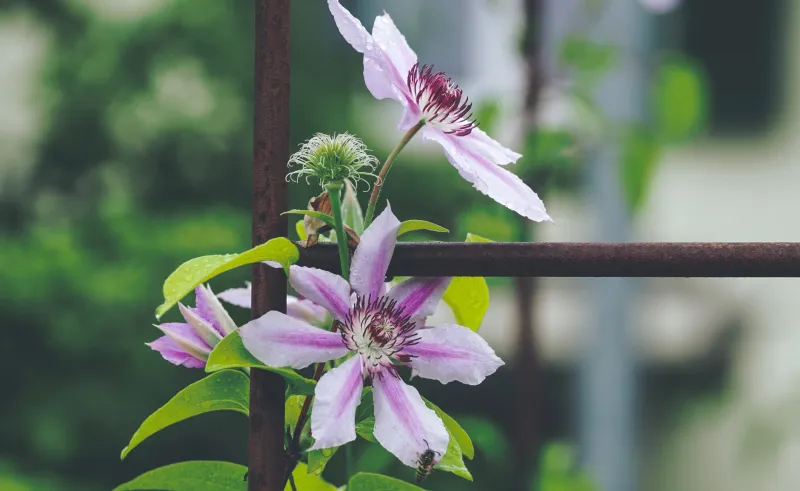
For sheltered, sunny spots, star jasmine is a lovely choice, though it needs a mild position and a warm wall to do well. Climbing roses, honeysuckle and clematis can all work on a sunny boundary with the right support. On shadier fences, climbing hydrangea is a steady, self-clinging option, though it needs space and patience. Ivy is a familiar shade-tolerant climber, but it is vigorous and needs firm control; keep it off timber unless it is on a proper support system with a clear air gap.
Wisteria is spectacular, but it is not a fence plant in the ordinary sense. It needs strong, permanent support and regular pruning. If you want that look on a boundary, plan for a sturdy frame and accept that the fence is merely the backdrop. For something lighter, annual climbers such as cobaea can be useful for quick cover while slower plants establish.
Fixings That Keep a Gap
This is where a planted boundary succeeds or fails. Do not let climbers scramble directly over timber. Use a trellis, wire system or vine eyes to create a buffer. Vine eyes are small metal eyes screwed into the fence, with tensioned wires run between them. They hold the plant a few centimetres proud of the boards, which helps air move behind the foliage.
Trellis should be mounted on battens rather than pinned flat to the fence. Those battens create a ventilated gap. The same principle applies to any screen or support: air behind the plant is good; a sealed pocket of damp foliage is not. Stainless or coated fixings are worth the small extra cost, especially in exposed coastal gardens where ordinary metal can corrode quickly.
Check fixings once a year. A climber puts weight on its support, and wind adds movement. A loose vine eye or a sagging wire is easier to sort in autumn than after a winter gale has pulled the whole lot sideways.
Planting Pointers
Plant slightly away from the fence itself, not hard against it. A gap of around 30–45cm gives roots room and keeps the base of the plant out of the driest strip of soil. Improve the planting hole with organic matter, water well through the first season and mulch around the root zone without piling mulch against the stem.
Think about the fence’s base, too. If the boundary sits in a narrow border, choose a climber that will not demand constant watering and feeding. A plant that sulks in dry shade will never look generous, however good the support. In tighter spots, a wall shrub such as pyracantha or ceanothus can give structure and privacy without needing to scramble upwards.
The Maintenance That Makes It Last
A planted fence is not a no-maintenance fence. It is a living boundary, and living boundaries need a little direction. Tie in new growth while it is flexible. Prune after flowering where appropriate. Keep climbers from creeping into gutters, windows and neighbouring airspace. And do not let a vigorous plant bury the fence so completely that you cannot see the timber beneath.
That last point matters for more than aesthetics. A dense curtain of foliage can hide a problem with posts, boards or fixings until it is serious. A routine check each spring and autumn keeps you ahead of it. Clear leaves from the foot of the fence, keep the air gap clear and trim back anything that is pressing against the boards.
A Boundary That Earns Its Keep
Greening a fence is not about hiding it. It is about giving it a second job: softening hard lines, adding seasonal interest and creating a bit more privacy without building higher. Done with sensible fixings and the right plants, a planted boundary can look established and generous while still letting the timber breathe. That is the sort of garden improvement that keeps paying back, season after season.