The Shared Corner, Solved: Fencing the Point Where Three Plots Meet
A corner where three gardens meet is rarely a design triumph. More often it is a triangle of leftover grass, three fences arriving at slightly different angles, and a quiet understanding that nobody is entirely sure who owns what. Yet this is one of the most visible junctions in the garden: you see it from the kitchen window, your neighbours see it from theirs, and every boundary decision ripples outward. Treat it as a small piece of architecture rather than an afterthought, and the awkward corner becomes the cleanest part of the plot.
Begin with the paperwork, not the posts
Before you measure anything, dig out the title plan and any conveyancing documents. Land Registry plans are useful but general; they are not a setting-out drawing. If the line is unclear, ask each neighbour what they understand the boundary to be and whether they have any deeds, old photographs or receipts for previous fence work. An existing fence is evidence, not proof. It may have been put up by a previous owner in roughly the right place, or roughly the wrong one.
If the corner is shared, get agreement in writing before anyone lifts a panel. A simple note or email setting out the proposed line, height, materials and who is paying for what will save a lot of guesswork later. This is not about turning a garden into a legal file; it is about making sure three households remember the same conversation. If the ownership is genuinely disputed, take proper advice rather than assuming the fence nearest your lawn is yours.
Set out a line that works from all three sides
Old boundaries often stagger because each household replaced its own run at a different time. A fair line does not have to be perfectly straight, but it should be simple, visible and agreed. Set out a string line between fixed points and look at it from all three gardens, not just your own. Check how it affects light, access, planting space and the shape of each plot. A line that gains you half a metre may leave a neighbour with a useless strip.
If one garden is much smaller, a stepped line can be kinder than a single diagonal. If a shed, tree or drain sits close to the junction, work around it early rather than discovering it when the posts are in. Leave enough room for maintenance, and make sure nobody has to climb over a border to paint a rail or clear leaves. A good boundary line is boring in the best way: obvious, practical and easy for everyone to live with.
Choose heights that make sense from every window
Privacy needs differ. A household with an overlooked patio may want a solid 1.8m run, while the neighbour on the higher ground may feel that same fence is already a wall. Use height deliberately. A rear corner might step from 1.8m down to 1.5m near a seating area, or use a slatted upper section to keep light moving while blocking sightlines. What matters is how the fence reads from each side, not just from yours.
Remember that garden fence heights can be affected by permitted development rules, conservation areas and listed buildings. If you are unsure, check with your local planning authority before ordering timber. Height is a neighbourly decision as much as a technical one, and a well-judged step often looks more considered than one continuous slab of screening.
Pick materials that read as one boundary
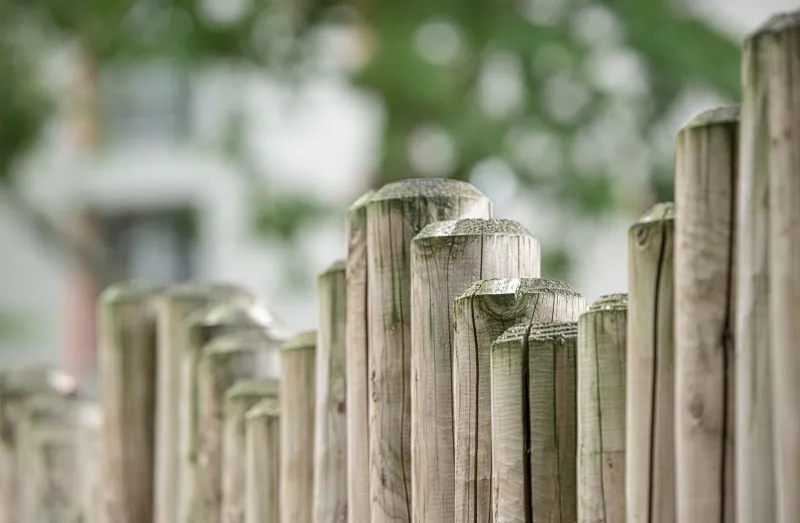
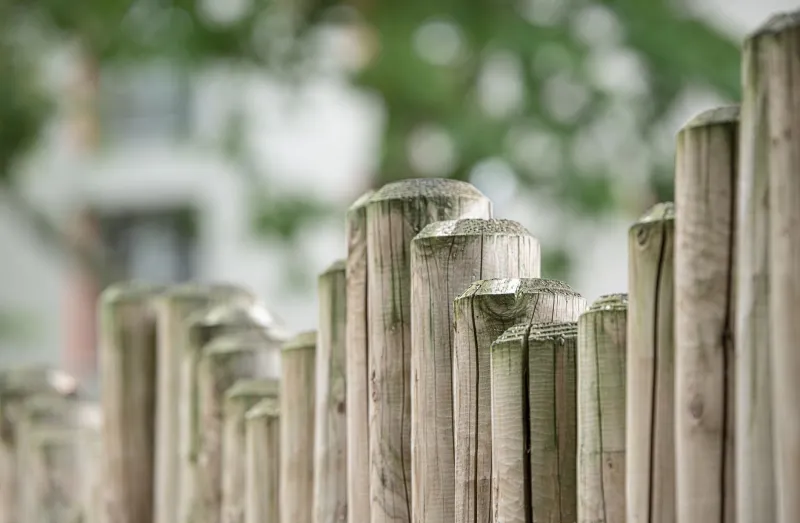
Three different fences meeting at one point will always look improvised. You do not need identical panels, but you do need a shared visual language. Agree on a timber species, a stain colour, a slat size or a brick pier detail. One household might own one run and another household the next, but if the posts, caps and gravel boards relate to each other, the corner feels intentional.
Warm timber remains the easiest material to blend across three gardens, especially if everyone uses pressure-treated boards and stainless fixings. Charcoal can look sharp, but it can also read as a solid wall in a small space. If budgets differ, agree on the structure first: a consistent post size, a shared pier at the junction and matching gravel boards will do more for the corner than three expensive but unrelated fences.
Detail the junction itself
Where three runs meet, avoid three posts fighting for the same square foot. A single sturdy corner post or a small masonry pier gives the junction one clear centre. Set it on a proper foundation, cap it neatly and make sure the rails or panels meet cleanly rather than overlapping by guesswork. A bespoke corner panel may cost a little more, but it will look far better than three standard panels crammed together.
Keep the bottom line continuous. Gravel boards should follow the same level where possible, and drainage must not be blocked by a new post or plinth. If you are using slatted screens, line up the slats across each run so the eye reads one boundary rather than three separate attempts. The junction should look like it was drawn, not discovered.
Add privacy without turning the corner into a fortress
Planting softens hard edges and gives each household something to look at other than fence panels. A small tree, a clump of bamboo in a root barrier or a few shade-tolerant shrubs can make the corner feel greener without stealing everyone's light. Climbers can work well if they are kept on their own side and not allowed to push through gaps.
Privacy is not only about height; it is also about what you can see through. A slatted screen at the top of a solid fence can take the edge off an overlooked window while letting air and late-afternoon light through. Just keep maintenance in mind. A corner that is easy to inspect, clear and repair will stay looking crisp for far longer than one that needs a ladder and a neighbour's permission every time it needs attention.
Keep the conversation going
A three-way corner works best when all three households know what is happening and why. Talk early, share drawings if you have them, and agree how future maintenance will be handled. If the fence is shared, put the arrangement in writing, even if it is only a short note. A corner that three people understand is much less likely to become a corner that three people argue about.
Get the line, the height and the junction detail right, and the rest of the boundary becomes much easier. That odd triangular patch stops being the place where fences collide and starts being the point where three gardens meet with a bit of care.