Gaps That Work Harder: Why British Gardens Are Falling for Slatted Screens
For a long time, the answer to an overlooked garden was a single, blunt solution: six feet of solid timber, fixed to posts, finished by lunchtime. It works, in the sense that a drawn curtain works. But it also turns a boundary into a wall, and walls do strange things to small British gardens — they block the low winter sun, they catch the wind instead of letting it through, and they make the far end of a plot feel further away than it is.
Which is roughly why slatted screens have quietly taken over. Wander round any garden show, any new-build development, any row of Victorian terraces with a decent-sized back garden, and you'll spot the same thing: narrow timbers set with deliberate gaps, sometimes horizontal, sometimes upright, doing the job a solid panel used to do but with a much lighter touch.
Why the solid six-footer started to feel heavy
A solid panel is a compromise dressed as a certainty. You gain privacy and you lose light, and in a garden that's maybe eight metres wide, that loss is felt. North-facing plots go gloomy. Small courtyards start to feel like corridors. And because a solid fence stops the breeze dead, wind that would otherwise pass through gets pushed up and over, swirling back down behind it — the classic reason a sheltered corner still manages to be windy.
A slatted or hit-and-miss screen behaves differently. The gaps break up the airflow, so gusts lose energy as they pass through. Light comes through at an angle, which means a boundary that faces the sun can still throw a soft wash of brightness across a border in the afternoon. And crucially, the eye reads the screen as a boundary rather than a barrier — you can see there's something beyond it, even if you can't see what.
The privacy maths of a gap
There's no universal number, but the principle is straightforward. The narrower the gap relative to the slat, the more you conceal — and the more you need to think about sightlines.
As a rough guide, slats of around 45–70mm with gaps of 10–20mm give a good balance: you get the visual texture and the airflow, but from a normal standing or seated position a few metres away, very little is actually visible. Wider gaps — 30mm and up — are better thought of as screening rather than privacy. They're lovely behind planting or as a divider between zones, but they won't stop a determined glance from a first-floor window next door.
Angle matters as much as width. Horizontal slats tilt the sightline downward if you're looking from above, so a screen with sloping slats (sometimes called a louvre or angled profile) can block a view from a neighbouring upstairs window while letting light in at eye level. If your main concern is an overlook from height, that's the profile worth asking about. And remember that privacy is directional: work out exactly which window or angle you're screening, then stand there and check before anything gets fixed down.
Horizontal or vertical?
Horizontal slats run with the landscape. They make a boundary feel wider and lower, and they suit modern gardens, gravel borders and anything with a strong horizontal line — a low roof, a long bench, a raised bed. They also collect less debris, which matters in a country with this much weather.
Vertical slats pull the eye upward and add height without adding bulk. They're the better choice where the fence line is tall and you don't want it to read as a solid mass, and they pair well with traditional planting — roses, climbers, anything that wants to scramble. Vertical also tends to handle a slight slope more gracefully, since the eye follows the uprights rather than a stepped horizontal line.
Timber, aluminium and the British weather
Timber is the obvious choice and, for most gardens, the right one. Slatted cedar and thermally modified softwood both hold up well and weather to that soft silver-grey most people are after. Cheaper softwood works perfectly happily if it's treated properly and refinished every couple of years — it will simply need more attention. Whatever you buy, check it's from a responsible source; the FSC label is the easy shorthand.
Aluminium screens cost more up front and look crisper, more architectural. They don't swell, warp or need oiling, and powder-coated finishes now come in a genuinely good range of muted tones. In a coastal garden, or anywhere with persistent damp, they're worth the premium.
Posts, fixings and the wind question
A screen is lighter than a solid panel, but it's also more porous — which means it catches wind differently rather than not at all. Posts still need to be substantial, set at proper depth in concrete, and braced at corners and ends. If a run is long, expect to add intermediate posts at shorter centres than you would for solid boards.
Fixings deserve a mention too. Stainless steel screws, not galvanised, in anything that will get wet. And leave a small gap between the bottom slat and the ground — 50mm or so — so air can move and timber can dry.
Planting the gaps
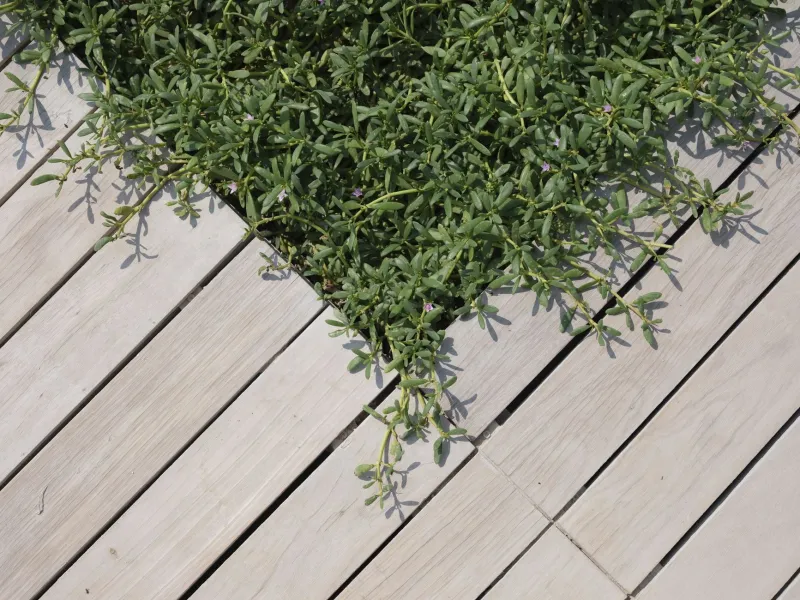
This is where slatted screens earn their keep. Because light passes through, plants on both sides grow towards the boundary rather than away from it. A screen with a Gertrude Jekyll rose on one side and a fern or two in the shade on the other looks less like a fence and more like a garden that happens to have a structure in it.
Climbers need help on slats — a slim trellis fixed to the posts, or a few horizontal wires, gives them something to grip. And a narrow border along the base, even 300mm of it, softens the junction between screen and ground better than any amount of gravel board.
The see-through boundary isn't about giving up privacy. It's about choosing exactly how much you need, and letting the rest through.